
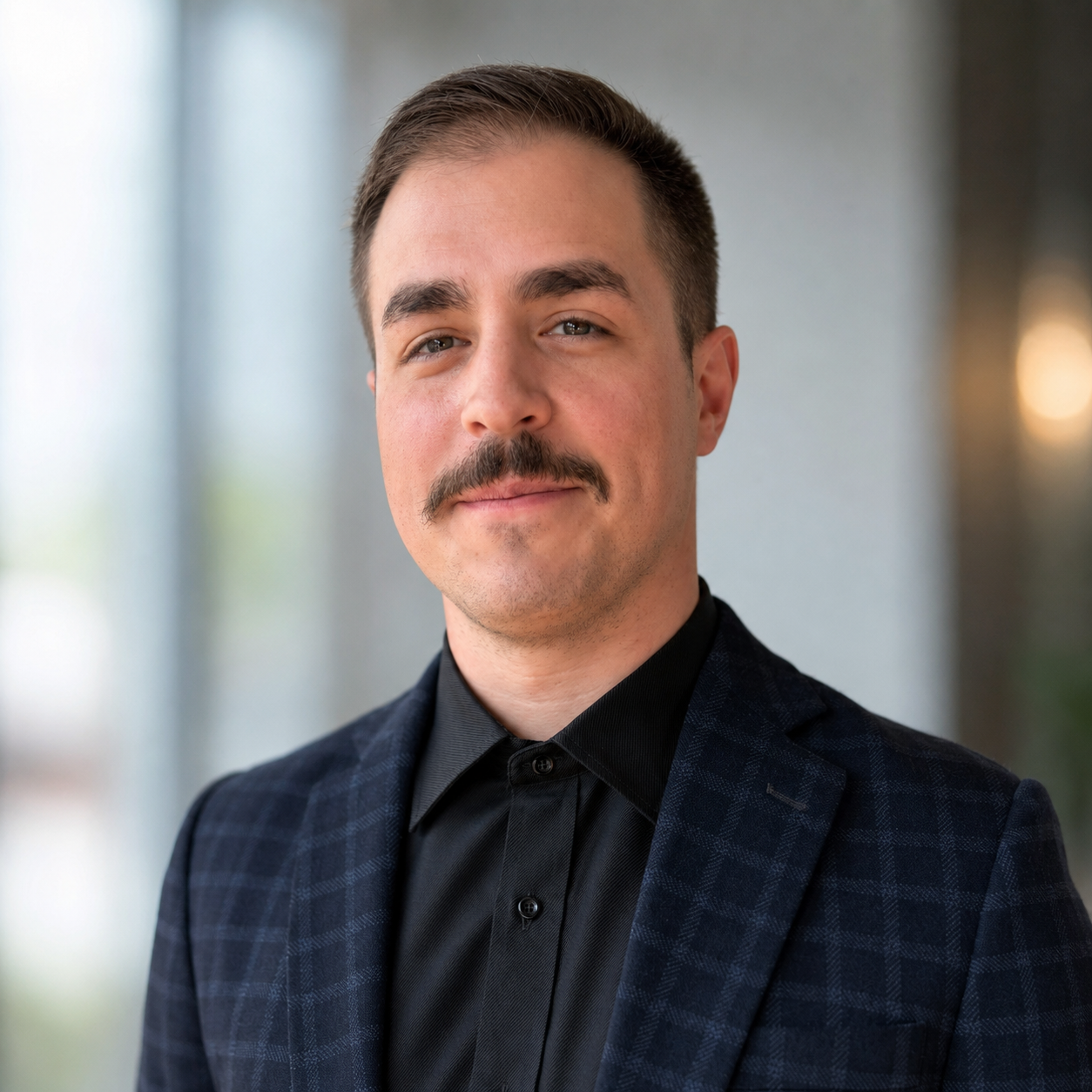

In 2024, Erik Schulte’s life looked like a case study in winning. He became a Director in January. He closed his first deal over ten million dollars in July. He took the stage at a sold-out national conference in August as a subject-matter expert on artificial intelligence. He was running a global webinar series, was in the best relationship he’d ever had, and was living in the nicest apartment of his life. Every box a high performer is supposed to check was checked.
By August 24th, he was on a hospital bed asking doctors whether he would walk again.
Schulte had spent the previous months chasing the next thing. Faster bikes, harder roads, projects bigger than the last. The acceleration ended at a guardrail on the way home from Golden, Colorado. He hit it somewhere north of one hundred miles per hour. He flew fifty feet out and fifteen feet down. He broke three vertebrae in his back, both arms, a finger, seven ribs, and nine teeth. He was in full armor and a full-face helmet.
“I had every external marker of success I was supposed to have,” Schulte says now. “I just didn’t notice that the scoreboard I was playing on was incomplete.”
That sentence has become the spine of his work.
The Incomplete Scoreboard
In Schulte’s framing, most high performers are running an optimization problem with too few variables. They track financial performance with obsessive precision. They track professional advancement quarterly. They count followers, deals, titles, square footage. What they don’t track, until the body forces them to, is everything else. Physical health, mental health, relationships, spiritual alignment, the quality of any given Tuesday morning at 10am.
“The collapse doesn’t happen because you’re failing,” he says. “It happens because you’re winning on the metrics you’re tracking and losing badly on the ones you’re not. The wins keep coming, the dashboards keep lighting up green, and meanwhile, the parts of your life you stopped looking at are quietly burning down.”
For Schulte, the burning-down period was visible in retrospect but invisible at the time. He had gained nearly sixty pounds since fighting as an amateur boxer at the MGM in Boston a year earlier. He had spent most of his free time numbing, chasing speed and noise and anything that drowned out the silence. None of it had registered as a problem because his job title, his bank account, and his LinkedIn profile all looked exactly the way they were supposed to.
The Hospital Bed
Three weeks into recovery, alone in a room he could not leave, on a cocktail of opioids and muscle relaxants, Schulte ran out of distractions. The video games were beyond his motor function. The television felt like the cursed crew in Pirates of the Caribbean, eating food that tasted like ash. He was left with his own thoughts, and the question that surfaced was uncomfortable. How did I get here?
The answer, he eventually concluded, was that he had. Not anyone else.
“My first instinct was to look for someone to blame,” he says. “My girlfriend, my employer, the world. But the only common thread was me. I had been treating myself like a problem to solve rather than a life to live.”
The shift was not euphoric. It was not, in his telling, a revelation. It was, more accurately, a kind of refusal. He had watched his own father, a former Air Force fighter pilot with a broken back of his own, spend decades blaming the world for his decline. Schulte saw a fork in the road. He could become his father. Or he could do the work.
He chose the work.
A Different Set of Tools
What Schulte teaches now is not a return to balance, and not a softer version of ambition. He is impatient with the genre of executive wellness that prescribes “do less” as the answer to burnout, and dismissive of the standard advice to find one’s purpose by sitting still long enough.
His objection is practical. The standard advice is built for the average person, and the average person is overweight, divorced, and broke. “If you have any aspiration to be above average,” he says, “then average advice will make you miserable.”
His framing instead borrows from engineering. Different machines require different fuels and different maintenance schedules. A Formula 1 car needs new tires every few laps. A sedan can go three years. Both are valid. Neither operates well on the other’s protocol. Most high performers, Schulte argues, have never bothered to figure out what kind of machine they actually are. What fuels them, what breaks them, what they need to run well over the long term. They suffer the consequences of running on the wrong specifications.
The work he does with executives is figuring out the specifications. What does a complete scoreboard look like for this person? What needs to be tracked? At what cadence? With what corrective actions when the gauges start drifting?
The Test Most People Skip
One of Schulte’s recurring observations is that high performers spend years fantasizing about the exit. Quitting the corporate path, moving to Thailand, becoming a scuba instructor, opening a bar in a small town. They invest enormous psychological energy in the fantasy and almost no time actually testing whether the fantasy holds up.
Schulte tested his. He spent a week in Koh Tao earning advanced diving certifications. He spent a week in Chiang Mai training Muay Thai twice a day. He liked both. He returned to corporate work clearer.
“They were fun vacations,” he says. “They were not lives. The problem with you not being fulfilled isn’t your company. It’s you. You are the problem. You, the beautiful part, are also the answer.”
The takeaway, in his view, isn’t that the exits are wrong. It’s that most people pursue them as fantasies precisely because they never test them, and the untested fantasy can absorb infinite emotional bandwidth that would be better spent on the life actually in front of them.
Where the Work Goes Next
Schulte now serves as a vice president at a family office deploying over one hundred and fifty million dollars in assets under management. He has completed two ultramarathons since being told he might never walk again. He speaks to leadership teams and executive audiences on what he calls “the incomplete scoreboard” and the architecture of a life that holds up under high performance.
He is wary of being mistaken for a recovery speaker, or a vulnerability speaker, or a guru. He prefers a different framing. A high performer who survived his own warning shots and is now interested in helping other high performers see theirs before the guardrail.
“Most people will not need a near-fatal accident to learn what I had to learn in a hospital bed,” he says. “But they will need to stop running long enough to notice they have a choice.”