
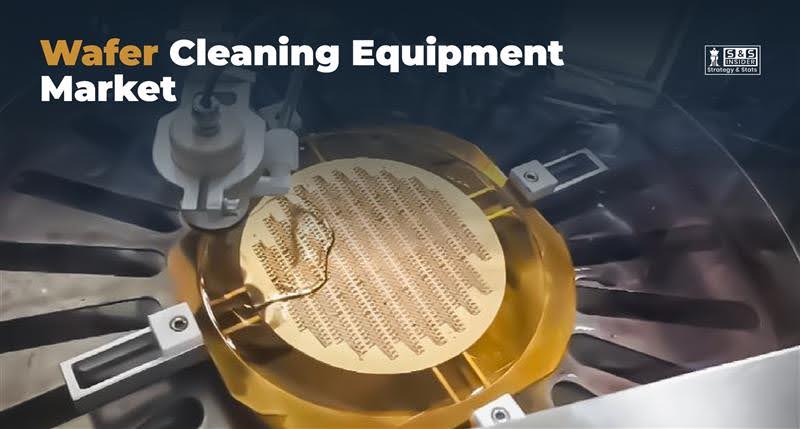

The Wafer Cleaning Equipment Market size was USD 10.23 Billion in 2025E and expected reach USD 15.61 billion till the end of year 2033 with CAGR of 5.43% over the forecast period 2026-2033 — this projected growth trajectory highlights the strengthening demand for advanced cleaning solutions in semiconductor fabrication. As semiconductor nodes shrink and wafer diameters expand, the complexity and precision required in cleaning processes have become paramount. Advances in logic, memory, and power devices are driving manufacturers to invest in state-of-the-art cleaning equipment that can deliver ultra-high purity and defect-free wafers. The performance of cleaning tools directly impacts yield and device reliability; therefore, industry leaders are prioritizing technologies that minimize particulate contamination, organic residues, and metal ions during manufacturing cycles. As a result, the wafer cleaning equipment market is witnessing a paradigm shift toward automation, chemical optimization, and environmentally sustainable practices that align with broader industry goals.
The Wafer Cleaning Equipment Market is anticipated to benefit from the expansion of next-generation semiconductor fabs and the push toward 3nm and below process technologies. The semiconductor industry’s ongoing evolution—driven by artificial intelligence, 5G, electric vehicles, and the Internet of Things (IoT)—necessitates rigorous wafer preparation and cleaning at every production stage. High productivity, reduced cycle times, and integration with advanced process control systems are becoming crucial attributes for cleaning solutions. Equipment providers are competing to offer platforms that deliver superior throughput without compromising on cleaning efficacy. This dual focus on performance and efficiency is expected to underpin the market’s growth through 2033, shaping new benchmarks for precision and operational excellence throughout the semiconductor manufacturing ecosystem.
Market Drivers
A primary driver fueling market expansion is the relentless demand for smaller, more powerful, and energy-efficient chips. As transistor geometries scale down, surface contamination that may have been negligible in larger nodes now poses significant risks to yield and device performance. This has amplified the importance of sophisticated cleaning mechanisms capable of addressing sub-nanometer particulates and ultra-thin film residues through advanced chemistries and plasma techniques. Moreover, the integration of in-situ metrology and real-time monitoring within cleaning equipment enables manufacturers to detect and rectify process deviations quickly, enhancing overall fab productivity.
Another substantial driver is the growing adoption of 3D architectures such as 3D NAND and FinFETs, which introduce complex topographies requiring tailored cleaning approaches. Traditional wet and dry cleaning methods are being complemented by hybrid systems that offer flexibility and higher precision, catering to diverse wafer surface conditions. The rise in demand for power semiconductors in automotive and renewable energy applications has also stimulated investment in cleaning technologies optimized for larger wafer sizes, such as 300mm and beyond, to facilitate high-volume production with stringent quality standards.
Environmental and regulatory pressures are also shaping the wafer cleaning equipment market. Semiconductor manufacturers are increasingly focused on minimizing the environmental footprint of their operations, which includes reducing chemical consumption, wastewater generation, and energy usage. Equipment suppliers are responding by developing solutions that incorporate eco-friendly chemistries, closed-loop recycling systems, and energy-efficient components. These advancements not only support sustainability goals but also reduce operational costs over the long term, appealing to fabs seeking both performance and environmental compliance.
Future Outlook
Looking ahead, the wafer cleaning equipment market is poised for steady growth as the semiconductor industry continues to innovate and adapt to emerging technologies. One of the most exciting prospects is the integration of artificial intelligence and machine learning within equipment controls. Predictive maintenance, adaptive process tuning, and enhanced defect detection are set to transform cleaning operations from reactive to proactive frameworks, reducing downtime and improving yield consistency across production lines.
The increasing prevalence of smart manufacturing and Industry 4.0 principles will further bolster demand for connected, data-driven cleaning systems that can communicate seamlessly with other fab equipment. This interconnected ecosystem will enable real-time analytics, facilitating rapid decision-making and process optimization. Additionally, as new materials such as gallium nitride (GaN) and silicon carbide (SiC) gain traction for high-power and high-frequency applications, specialized cleaning solutions tailored to these substrates will open new avenues for market growth.
Global supply chain dynamics may also influence investment decisions around wafer cleaning infrastructure. Efforts to diversify manufacturing capabilities across regions have accelerated, prompting semiconductor companies to expand or modernize fabs in varied geographies. While this blog focuses on overarching market trends without diving into regional breakdowns, it’s evident that strategic fab deployments will drive localized demand for advanced cleaning technologies in emerging semiconductor hubs.
Conclusion
In conclusion, the wafer cleaning equipment market is entering a phase of sustained and meaningful growth, underpinned by critical technological advancements and shifting industry requirements. From shrinking process nodes to complex device architectures and sustainability imperatives, multiple forces are converging to elevate the importance of wafer cleaning throughout semiconductor production. With the market projected to grow from USD 10.23 billion in 2025E to USD 15.61 billion by 2033 at a CAGR of 5.43%, stakeholders across the value chain have significant opportunities to innovate and capture value in this essential segment of semiconductor manufacturing.
Frequently Asked Questions (FAQ)
What does a CAGR of 5.43% indicate for the wafer cleaning equipment market?
A CAGR of 5.43% means that the market is expected to grow at a steady annual rate of 5.43% between 2026 and 2033, reflecting consistent demand and investment in cleaning technologies over this period.
What is meant by the forecast period 2026–2033?
The forecast period refers to the future time frame during which market growth, trends, and projections are analyzed—in this case from the beginning of 2026 through the end of 2033.
How does regional growth impact the wafer cleaning equipment market?
Regional growth influences where semiconductor fabs are established and expanded, which in turn drives local demand for wafer cleaning equipment as manufacturers invest in cutting-edge tools to support production capacity and technological advancement.