
The Autonomous Mobile Robots for Logistics and Warehousing Market is emerging as a cornerstone of modern supply chain transformation. As global warehouses, distribution centers, and logistics hubs face rising labor shortages, cost pressures, and demand for faster order fulfillment, autonomous mobile robots (AMRs) are becoming indispensable. These robots are designed to navigate warehouse environments independently, optimize material handling, and significantly enhance operational efficiency. With e-commerce expansion, omnichannel retail, and Industry 4.0 adoption accelerating worldwide, AMRs are no longer optional innovations—they are strategic assets driving competitiveness and scalability across logistics and warehousing operations.
Autonomous Mobile Robots for Logistics and Warehousing Market Size and Growth Outlook
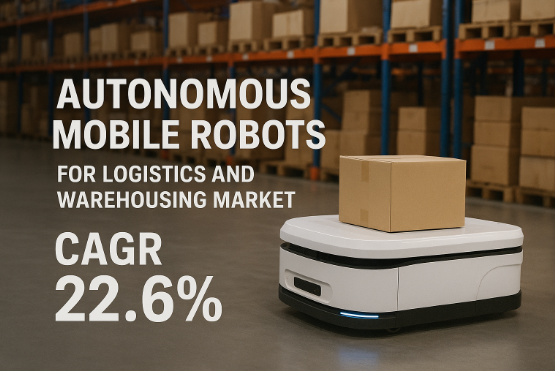
According to the SNS Insider, The Autonomous Mobile Robots for Logistics and Warehousing Market demonstrated strong momentum in 2023, reflecting growing automation investments across industries. In that year, the market generated USD 2.96 billion in revenue and is projected to surge to USD 18.56 billion by 2032, expanding at an impressive compound annual growth rate (CAGR) of 22.6% throughout the 2024–2032 forecast period. This exponential growth highlights the increasing reliance on autonomous robotic systems to improve productivity, reduce human error, and manage high-volume warehouse operations with greater precision and speed.
Leading Autonomous Mobile Robots for Logistics and Warehousing Companies are:
IAM Robotics, Geekplus Technology Co., Ltd., KUKA AG, Fortna Inc., Locus Robotics, Teradyne Inc., OMRON Corporation, Fetch Robotics, GreyOrange, Clearpath Robotics Inc., Boston Dynamics, Conveyo Technologies, InVia Robotics, 6 River Systems, Savioke, Robotnik Automation, DHL Supply Chain, SoftBank Robotics, Adept Technology Seegrid and others.
Key Drivers Boosting the Autonomous Mobile Robots for Logistics and Warehousing Market
Several powerful factors are propelling the Autonomous Mobile Robots for Logistics and Warehousing Market forward. One of the most influential drivers is the explosive growth of e-commerce and same-day delivery expectations. Warehouses must process thousands of orders rapidly, and AMRs enable seamless goods movement without the constraints of fixed infrastructure. Additionally, chronic labor shortages in logistics-intensive economies are pushing companies toward automation solutions that ensure operational continuity.
Rising warehouse rental costs and the need to maximize space utilization further amplify AMR adoption. These robots can operate in narrow aisles, work collaboratively with human staff, and easily scale with fluctuating demand—making them a cost-effective long-term investment for logistics providers.
Technology Advancements Shaping the Autonomous Mobile Robots for Logistics and Warehousing Market
Technological innovation is a defining force behind the Autonomous Mobile Robots for Logistics and Warehousing Market. Advances in artificial intelligence, machine vision, LiDAR, and sensor fusion have transformed AMRs from simple transport units into intelligent decision-making systems. Modern robots can dynamically map environments, avoid obstacles, optimize routes, and integrate seamlessly with warehouse management systems (WMS).
Cloud connectivity and data analytics are also enhancing robot performance by enabling predictive maintenance and real-time optimization. As software capabilities continue to evolve, AMRs are becoming smarter, more flexible, and capable of performing complex tasks such as goods-to-person picking, pallet transport, and cross-docking operations.
Benefits Driving Adoption in the Autonomous Mobile Robots for Logistics and Warehousing Market
The Autonomous Mobile Robots for Logistics and Warehousing Market is expanding rapidly due to the tangible benefits AMRs deliver. These include improved operational efficiency, reduced fulfillment cycle times, and lower dependency on manual labor. AMRs improve workplace safety by minimizing repetitive lifting and reducing forklift traffic, which significantly lowers accident risks.
Moreover, autonomous robots offer scalability unmatched by traditional automation systems. Businesses can deploy additional robots during peak seasons and redeploy them when demand subsides. This flexibility makes AMRs particularly attractive for fast-growing e-commerce retailers and third-party logistics providers.
Challenges Impacting the Autonomous Mobile Robots for Logistics and Warehousing Market
Despite strong growth prospects, the Autonomous Mobile Robots for Logistics and Warehousing Market faces certain challenges. High initial investment costs can be a barrier for small and mid-sized enterprises. Integration with legacy warehouse infrastructure and existing software systems may also present technical hurdles.
Additionally, concerns related to cybersecurity, workforce displacement, and the need for skilled personnel to manage robotic fleets can slow adoption in some regions. However, declining robot costs, robot-as-a-service (RaaS) models, and supportive government initiatives are gradually mitigating these challenges.
Regional Outlook of the Autonomous Mobile Robots for Logistics and Warehousing Market
Regionally, North America holds a dominant share of the Autonomous Mobile Robots for Logistics and Warehousing Market, driven by early technology adoption, strong e-commerce penetration, and major investments by large retailers and logistics firms. Europe follows closely, with increasing focus on warehouse automation, labor efficiency, and sustainability.
The Asia-Pacific region is expected to witness the fastest growth during the forecast period. Rapid industrialization, expanding manufacturing bases, and booming e-commerce markets in China, Japan, South Korea, and India are fueling demand for AMRs. Supportive government policies and rising smart warehouse adoption further strengthen the region’s growth outlook.
Future Opportunities in the Autonomous Mobile Robots for Logistics and Warehousing Market
The future of the Autonomous Mobile Robots for Logistics and Warehousing Market is rich with opportunity. Integration of AMRs with collaborative robots, autonomous forklifts, and AI-driven warehouse ecosystems will redefine end-to-end logistics automation. Sustainability initiatives are also encouraging companies to deploy energy-efficient robotic systems that reduce carbon footprints.
As robot intelligence advances and prices become more accessible, AMRs will expand beyond large enterprises into small warehouses, retail backrooms, and micro-fulfillment centers. This widespread adoption will further accelerate market growth and innovation.
Frequently Asked Questions (FAQs)
Q1. What is the CAGR of the Autonomous Mobile Robots for Logistics and Warehousing Market?
The market is projected to grow at a CAGR of 22.6% during the forecast period from 2024 to 2032, reflecting strong global demand for warehouse automation solutions.
Q2. What is the forecast value of the Autonomous Mobile Robots for Logistics and Warehousing Market by 2032?
By 2032, the Autonomous Mobile Robots for Logistics and Warehousing Market is expected to reach USD 18.56 billion, driven by rising e-commerce activity and labor automation needs.
Q3. Which region is expected to grow fastest in the Autonomous Mobile Robots for Logistics and Warehousing Market?
The Asia-Pacific region is anticipated to experience the fastest growth due to rapid industrial expansion, e-commerce growth, and increasing investments in smart warehouse infrastructure.