


Many might think that their credit score is a fixed number that clearly shows their financial standing. In reality, that number can shift depending on the data used to calculate it. The tri-merge standard is the most reliable way to produce a complete understanding of a person’s creditworthiness that helps reduce risk and uncertainty by consolidating data from the top three Nationwide Consumer Reporting Agencies (NCRAs).
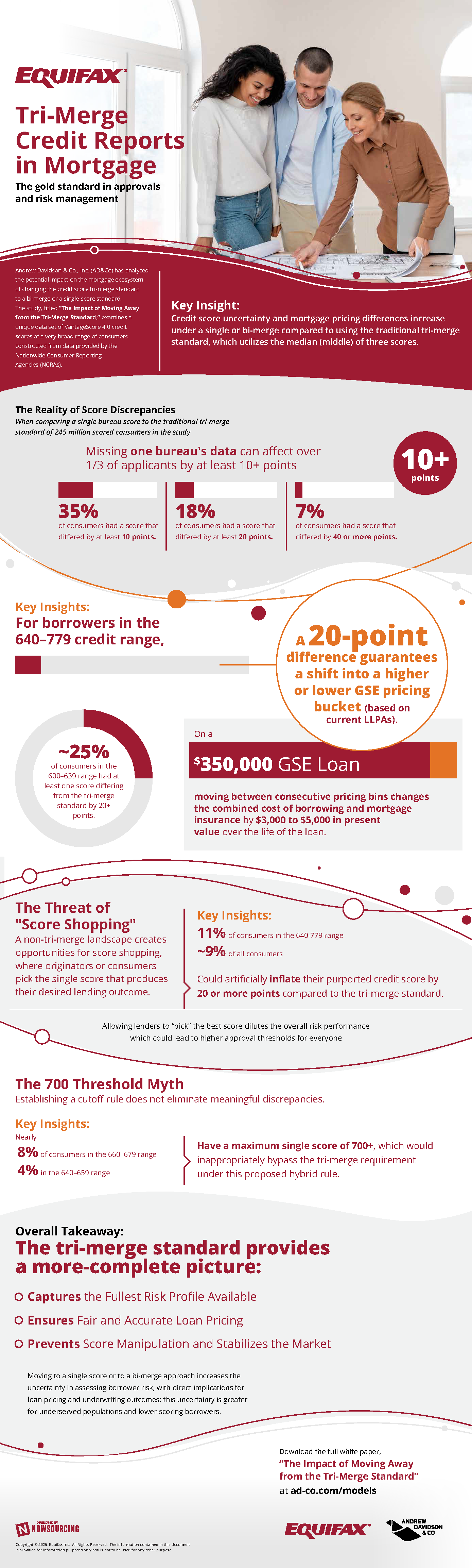
A key aspect of credit scores is that they are not perfectly aligned across reporting systems. Differences in how data is collected, updated, and reported can lead to noticeable variations in credit scores for the same person and influence loan outcomes. Mortgage pricing is structured around credit score ranges, so even a small shift can move a borrower to a separate pricing tier, directly affecting interest rates and total borrowing costs. Over the life of a loan, this could cost a borrower thousands of dollars. So a minor variation in data can significantly affect long-term financial outcomes.
A more comprehensive data set helps reduce variability by capturing a fuller picture of a borrower’s credit standing. By incorporating multiple data sources, lenders are able to more easily identify tradelines and possible risks that might otherwise go unnoticed. This reduces surprises down the line and allows for a more accurate assessment of creditworthiness.
One of the most important aspects of credit assessments is consistency. Using the median score derived from multiple sources helps balance outliers and prevents a single report from skewing credit scores. This creates a more reliable framework for evaluating risk, ensuring that lending decisions are based on as much data as possible instead of a single snapshot.
While reducing the number of credit reports used in mortgage evaluations may seem to streamline operations or lower upfront costs, it introduces significant issues. With less data available, lenders experience more uncertainty when assessing risk as missing or inconsistent information makes it more difficult to determine a borrower’s true financial position, leading to less precise pricing and decreased financial opportunities for certain borrowers.
Unfortunately uncertainty with creditworthiness can ripple across the wider lending ecosystem. When risk becomes harder to measure, lenders and investors can respond by building additional safeguards. These safeguards frequently take the form of higher borrowing costs, stricter qualification standards, or both.
Another important consideration is the potential for inconsistent evaluation standards. Without a unified approach that incorporates multiple data sets, there may be increased opportunities for borrowers to select the most favorable credit score available. This practice, which is often referred to as “score shopping,” can distort risk assessments and impact lending decisions.
While relying on a single-score or bi-merge standard might offer short-term advantages for some borrowers, it undermines the consistency and transparency that the mortgage market depends on. Over time, these upfront savings will be offset by higher long-term costs, increased uncertainty, and reduced accuracy in risk assessment. Without data consistency, trust becomes an overwhelming issue.
The effects of reduced data quality extends further towards investors who fund mortgage credit lending. These investors depend on reliable credit data to assess the risk associated with mortgage-backed securities. If the data is perceived as more susceptible to manipulation, investors may demand higher returns to compensate for added uncertainty. This increased cost of capital can affect the entire system and result in higher interest rates for borrowers.
Cost efficiency is often the reason for the desire to simplify credit evaluations, but the largest financial challenges in mortgage credit lending comes from unclosed applications, often referred to as an uncompensated fallout. These incomplete transactions lead to lost time, effort, and resources for lenders.
Addressing this issue requires a strategic approach that goes beyond reducing data inputs. Early-stage tools such as soft credit checks can help assess a borrower’s eligibility before a full application is even submitted. Providing clear and transparent cost estimates near the first steps of the process can improve alignment between lenders and borrowers as well, making it less likely for applications to fall through and remain unfinished.
Advancements in credit scoring models have further improved the accuracy of determining creditworthiness while providing borrowers with the best rate by incorporating a greater range of financial data. In addition, evolving technology is accelerating data collection, giving lenders timely insight into a borrower’s financial stability and helping streamline the overall underwriting process.
With the lending market already struggling with affordability pressures and heightened investor expectations, cost-reduction efforts are adding another layer of complexity. While simplifying data inputs may offer short-term benefits, there is a greater chance that it will result in significant long-term risks that affect borrowers, lenders, and investors alike. Using a thorough overview of creditworthiness supports better decision-making, supports better pricing, and provides confidence to everyone involved. In a market where even small inconsistencies in data can have critical financial consequences, maintaining a comprehensive and reliable approach to credit evaluation remains essential.
Source: Equifax