

The global chemical industry has witnessed significant growth over the past decade, with aromatic compounds playing a pivotal role in various industrial applications. Among these compounds, benzene and its derivatives have emerged as essential building blocks for numerous chemical processes, making them indispensable in sectors ranging from pharmaceuticals to plastics and rubber. According to recent market analysis, the benzene and its derivatives market was valued at USD 34.2 billion in 2023 and is projected to reach USD 59.3 billion by 2032, growing at a CAGR of 6.3% during the forecast period from 2024 to 2032. This growth underscores the increasing industrial reliance on benzene derivatives and the expanding applications across multiple sectors.
Understanding Benzene and Its Derivatives
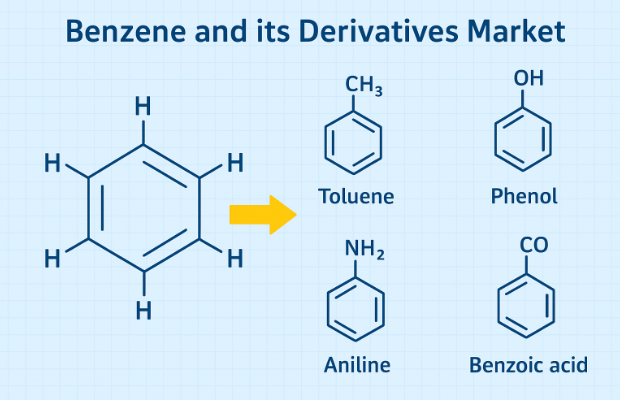
The Benzene and its Derivatives Market plays a crucial role in the global chemical industry, driven by the widespread use of benzene and its derivatives in various sectors. Benzene is an aromatic hydrocarbon with the molecular formula C₆H₆, whose unique structure and stability make it an essential precursor for derivatives such as toluene, xylene, ethylbenzene, phenol, and aniline. These compounds are critical in producing polymers, resins, synthetic fibers, dyes, and pharmaceuticals, making the market highly significant for industrial growth and innovation.The versatility of benzene derivatives is a key driver of the market. For example, styrene, a benzene derivative, is crucial for manufacturing polystyrene plastics, widely used in packaging, insulation, and consumer goods. Similarly, phenol is a fundamental precursor for epoxy resins and bisphenol A, which are essential in coatings, adhesives, and high-performance materials.
Key Market Drivers
- Rising Demand from the Plastics and Polymers Industry
The plastics and polymers industry remains the largest consumer of benzene derivatives. With the growing adoption of lightweight and durable materials in automotive, packaging, and electronics, the demand for benzene-based polymers continues to rise. Toluene and xylene, for instance, are integral in producing polymers and synthetic fibers, supporting the expansion of these industries globally. - Pharmaceutical Applications
Benzene derivatives play a crucial role in pharmaceutical synthesis. Aniline derivatives are widely used in drug manufacturing, while phenol derivatives are involved in producing antiseptics and other medicinal compounds. The increasing global demand for medicines and specialty chemicals fuels the growth of the benzene derivatives market, particularly in emerging economies. - Growing Construction Industry
The booming construction sector also contributes to benzene derivative consumption. Epoxy resins and adhesives derived from benzene compounds are essential in building materials, coatings, and sealants. As infrastructure projects increase worldwide, the demand for high-performance construction chemicals continues to grow, indirectly driving benzene derivative usage. - Expansion in Emerging Economies
Rapid industrialization and urbanization in Asia-Pacific, Latin America, and the Middle East have created significant opportunities for the benzene derivatives market. Countries such as China and India are witnessing increased production of plastics, rubber, and pharmaceuticals, which directly boosts the consumption of benzene-based chemicals.
Market Trends
Sustainability and Green Chemistry: As environmental concerns rise, chemical manufacturers are increasingly focusing on sustainable production methods for benzene derivatives. This includes adopting bio-based feedstocks and energy-efficient processes to reduce carbon footprints and regulatory risks.
Technological Advancements: Continuous innovation in catalytic processes and chemical engineering is enhancing the efficiency of benzene derivative production. This not only reduces costs but also improves product purity, meeting the demands of high-tech applications.
Diversification of Applications: Beyond traditional uses in polymers and pharmaceuticals, benzene derivatives are finding applications in advanced materials, electronics, and agrochemicals, further expanding the market potential.
Market Challenges
Despite its promising growth, the benzene derivatives market faces several challenges:
- Health and Environmental Concerns: Benzene is classified as a carcinogen, and strict regulations govern its production and handling. Companies must comply with safety standards, which can increase operational costs.
- Volatility of Raw Material Prices: Benzene is primarily derived from crude oil and coal tar, making the market susceptible to fluctuations in crude oil prices. This volatility can impact the overall pricing and profitability of benzene derivatives.
- Regulatory Pressure: Governments worldwide are implementing stringent environmental regulations to curb benzene emissions and ensure safe disposal practices. Compliance requires significant investments, especially for small and medium-scale manufacturers.
Future Outlook
The forecasted CAGR of 6.3% from 2024 to 2032 indicates a steady and promising growth trajectory for the benzene and derivatives market. The expansion will be driven by increasing applications in pharmaceuticals, plastics, construction, and advanced materials. Moreover, as industries continue to innovate and diversify their usage of benzene derivatives, the market is expected to see sustained demand.
Emerging technologies such as bio-based benzene production and recycling of aromatic compounds may reshape the market landscape, offering more sustainable and cost-effective solutions. Asia-Pacific is likely to remain a dominant market due to industrial growth and rising consumer demand, while North America and Europe focus on technological advancements and regulatory compliance.
Conclusion
The benzene and its derivatives market is poised for robust growth in the coming decade, driven by industrial demand, technological innovations, and expanding applications across multiple sectors. Valued at USD 34.2 billion in 2023 and projected to reach USD 59.3 billion by 2032, the market presents significant opportunities for manufacturers, investors, and stakeholders seeking to leverage the increasing global demand for aromatic chemicals. With a strategic focus on sustainability, efficiency, and diversification, the benzene derivatives industry is well-positioned to maintain its critical role in the global chemical landscape.