

Luca Caserta comes from an Italian theater family and once told his father he had only one certainty in life: that he would never follow in his footsteps. He grew up on stage and behind the scenes, yet as a rebellious teenager, he was convinced the family profession held nothing for him.
Life proved him wrong.
Today, Caserta is a director and screenwriter whose films have earned over 240 international awards. His short film The Reach, an adaptation of Stephen King’s lesser-known short story, secured the BAFTA-qualifying premiere at Carmarthen Bay Film Festival, won Best Foreign Short at Burbank International Film Festival, and earned Best International Short at Sedona International Film Festival. King himself described the film as “a lovely piece of work.” He also obtained the rights to Bruce Springsteen’s “Moonlight Motel” for the closing scene,a collaboration that adds a profound and evocative layer to the film’s atmosphere.
Growing up on King’s books and Springsteen’s music, seeing The Reach come to life with the blessing of these two world icons is an immense professional achievement and, obviously, a source of great personal satisfaction. A dream coming true.
This wasn’t luck. It’s the result of a filmmaker who trained at Rome’s most prestigious institutions, studied Prehistoric Archaeology, wrote and directed theatrical plays, and built a philosophy that treats every film like an archaeological site, layered, deliberate, and worth excavating for buried meaning.
The director who forged his own path from a theater legacy to study the craft of Cinema and now has Stephen King calling his film “a lovely piece of work”
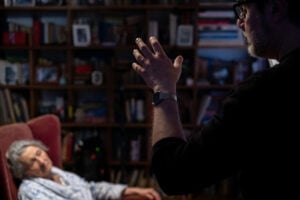
Caserta came from a theater family. He grew up breathing that atmosphere, participating in shows both on stage and behind the scenes at his father’s encouragement. The rebellion came later and Caserta initially decided to follow a completely different path.
After high school, he earned a Master’s Degree in Prehistoric Archaeology at the University of Verona. He loved the idea of investigating where humans come from, what our most remote origins are. The degree represented, he says, a perfect marriage between humanities and sciences, a union of multiple fields that allows for a broader, deeper vision of humankind.
During his university years, watching Stanley Kubrick’s 2001: A Space Odyssey became what he calls a “true Big Bang” in his head. It made him decide that one day he would become a director.
After university and a postgraduate specialization in communication, he decided to open his heart to theatre and made his debut as an author, writing and directing several theatrical plays in the family theatre company. But the pull of the camera had become undeniable. After a few years, he moved to Rome to formally master the craft of cinema.
“It’s been a journey of returning to my roots through a different lens,” he says.
He trained at the Cinecittà Film Academy, graduating in Directing and Screenwriting under the guidance of Neorealism master Carlo Lizzani and other prominent figures including Giuseppe Pinori, Daniele Nannuzzi, Mario Brenta, Giacomo Scarpelli, and Francesco Ranieri Martinotti. He deepened his study of cinematography at the Centro Sperimentale di Cinematografia with Giuseppe Lanci, and specialized further with Alessandro Pesci, Marco Bassano, and film production specialist Gianluca Arcopinto. He learned from editor Ugo de Rossi, whose practical insights shaped his post-production thinking.
This comprehensive training gave him what he calls a “360-degree view” of filmmaking, from writing to post-production, that allows him to maintain clear creative control over his artistic vision.
“I believe a director must know every aspect of filmmaking to best express their vision and effectively collaborate with every department involved in the creation of a work,” he says. “Beyond inevitable and useful technological evolutions, a film should never lose the craftsmanship of its heart.”
Builds films like archaeological digs — layer by layer, award by award, with 240+ international recognitions
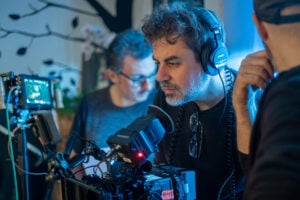
Caserta’s archaeology background didn’t stay in the classroom. It became a working methodology.
“My university studies provided me with a solid cultural foundation, but above all, they gave me a research methodology and an analytical mindset,” he says. “This resurfaces and is applied, more or less consciously, in my creative process. The way I approach an idea, a story, or a new project is the result of a fusion of inspiration, instinct, and rigorous preparatory study and research.”
He treats each story as a site to be carefully examined for buried connections and contextual layers. Objects and shots become symbols and metaphors to be decoded. He digs into the psychology of characters, their life experiences, and what he calls “the archaeology of memory” to bring out buried traumas and recollections.
“I work through layering, using metaphors and multiple levels of interpretation, so that every frame or scene is dense with deeper meanings, left for the viewer’s sensitivity and intuition to uncover,” he says.
This approach defines both his completed work and his process.
His first real breakthrough came with Tell Me Who I Am, released in 2020. The film addressed violence against women, memory loss, and the search for lost dignity and identity, topics he says remain “unfortunately still timely.” Its festival run was an “unstoppable escalation,” eventually winning 181 awards worldwide. The protagonist, played by Elisa Bertato (who also co-authored the screenplay), carries an intense and challenging role that demanded emotional precision. The soundtrack features Luciano Ligabue’s “Piccola stella senza cielo,” granted along with Warner Music—a track that serves as the film’s leitmotif.
The success brought him to the attention of international platforms and validated his belief that layered storytelling could reach both juries and general audiences.
The Reach: How Stephen King’s Favorite Story Became His Film

Caserta first encountered The Reach through its quiet, poetic, and touching tone. It stands in the vein of King’s most sensitive and lyrical storytelling, showcasing a profound emotional depth that often parallels his greatest dramatic works. Unlike many King narratives built on overt horror, this one “explores universal themes such as memory, roots, the cycle of generations, the inexorable passage of time, and love that transcends the boundaries of life.” He was particularly enchanted by the portrayal of spirits who appear to the elderly protagonist, Stella (masterfully played by Jana Balkan), not as frightening apparitions but as young, vibrant, and vital versions preserved in her memory.
“The spirits aren’t frightening or decaying figures,” Caserta explains. “They appear young, in the prime of their lives as she remembers them, filled with vitality and love. I believe the story carries a message of profound hope regarding what lies beyond the earthly dimension and invites the reader to find peace with their own destiny—aspects that I sought to convey in my adaptation.”
King has stated in interviews that among everything he has written, this story is what he most wants to be remembered for. That revelation mesmerized Caserta. It increased the weight of responsibility he already felt in adapting a legendary author who has shaped collective consciousness so profoundly.
He secured the film rights through the “Dollar Baby” program. The project was a massive production challenge, as Caserta wanted to do justice to the beauty and depth of the story, remaining faithful to its narrative heart while taking the creative liberties his directorial vision suggested.
“In the original story, there is a recurring question: ‘Do you love?’. It’s a true leitmotif that King poses to the reader and I pose to the audience,” Caserta explains. “Are we really sure we know what love is? Are we truly capable of loving someone? Is love something real?”
After viewing the finished film, Stephen King was kind enough to send the director a personal email, describing it as “a lovely piece of work.”
“It was an incredibly rewarding moment and I’m deeply honored,” the filmmaker adds. “I will forever be grateful for the trust he placed in me.”
While writing the screenplay, Caserta felt that Bruce Springsteen’s “Moonlight Motel”, an artist who means a great deal to him, could merge perfectly with the film’s themes in the final scene. “It’s a wonderful, delicate, and nostalgic song that speaks of memories, love, and what remains of love,” he says. Obtaining the rights was an “incredibly complex journey,” given Springsteen’s stature, but he succeeded. He states he is deeply honored by this collaboration and is “truly grateful to Bruce Springsteen and Sony Music.”
The film has now earned over 60 awards following its BAFTA-qualifying premiere. International press in cult magazines has praised it highly, Adam Groves on The Bedlam Files described it as “a standout in the Dollar Baby Pantheon,” and Jamie Zaccaria in Rue Morgue called it “spectacular” and “worthy of the King.”
The Balance of Instinct and Craft That Defines His Philosophy
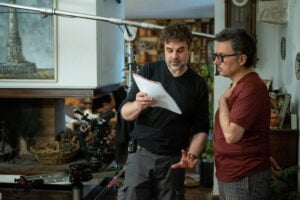
Caserta doesn’t work from formulas. He starts with an intuition that he explores and builds the film around in his mind. But he believes that when creating an artistic work, one must find the right balance between being cerebral and following instinct.
“Without that balance, the work risks losing the heart of the initial spark,” he says.
He’s always believed an author should find a unique voice, a result of vision and personality that sets them apart. But this must happen naturally, not through artifice. It must come from within, from what he calls “that creative furnace hidden in an intimate place where everything blends, and to which only the author has access.”
“The filmmaker is a bridge between that furnace and the film on the screen,” he explains. “It’s a creative forge, and it’s a path that evolves alongside the author’s own growth.”
Caserta’s cinematic vision is built on a delicate synergy of contrasting elements. “I’ve always been drawn to stories that inspire me, tackling strong, deep, and universal themes by interplaying social commitment, poetry, and rawness,” he explains. “I believe it’s sometimes necessary to give the audience a ‘punch to the gut’ to provoke reflection.”
His Italian roots play a role, but not in a limiting way. He’s absorbed the Italian cinematic tradition, particularly its focus on emotional truth and visual atmosphere, but he’s also consumed films from every continent, treating American cinema and international arthouse works with equal attention.
“I’ve absorbed the Italian cinematic tradition, and it certainly flows into my style and works,” he says. “However, I’ve always sought to express myself freely, finding my own voice to let it speak in the most personal way possible. All these stimuli have merged and reshuffled within me, along with my life experiences, in that remote place where ideas are born. It has made me who I am today, but not who I will be tomorrow, because I believe that each of us is in a constant state of becoming.”